
Imagine this: you are standing in your favourite bit of bushland, and you can detect – just by sniffing the air – every living thing that dwells there.
You can’t see nor hear most of the birds, mammals, insects or plants nearby. But they all shed tiny traces of themselves into the environment. Fragments of hair, skin cells, faeces, pollen, spores that drift on the breeze.
Your nose can’t smell them. Not even a dog’s nose could.
But a machine can. A machine can sample the air and read the faint traces of DNA those fragments carry.
This is the promise of eDNA technology, a newish and rapidly expanding field of science. And it is coming soon to a catchment near you…
It has certainly come to a catchment very near to me.
Not far from my home in the Adelaide Hills runs a waterway which is undergoing an environmental transformation: a six-kilometer length of Cox Creek, in Bridgewater, is being rehabilitated with the help of a four-year, $1.97 million Federal Government grant.
For those who don’t know it, Cox Creek is the largest of the two main waterways which flow from South Australia’s wettest peak – Mount Lofty – into the Onkaparinga River. The Onkaparinga River in turn fills the Mount Bold reservoir, which is one of Adelaide’s main water supplies. Like all waterways in the Adelaide Hills, Cox Creek and its catchment are severely degraded, with rampant invasive species and numerous other environmental problems.
For a long-time landcare volunteer like me, the Cox Creek transformation is an uplifting project to watch. Most environmental projects are wildly under-funded, and run for a year at best.
It depresses me that in the 37 years I have been involved in community landcare, no government of any persuasion in Australia has even come close to taking biodiversity conservation seriously.
So it is encouraging to see a well-funded project, even if it is focused on just one small sub-catchment in a continent of urgent need. A well-funded project is something for environmental volunteers to marvel at, and for local residents to engage in.
As chance would have it one of our local residents is Dr Andrew Baker, who for his day job runs an Adelaide-based technology company, called Data Effects, which specialises in developing end-to-end solutions for endemic and exotic pest and disease surveillance, mostly in agriculture and biosecurity.
Dr Baker heard about the Cox Creek Restoration Project, and has volunteered to run some ecology-focused eDNA testing. As the creek restoration project rolls out, he will be sampling the air (and he hopes later the water) to find out what is out there. The sampling will test for “presence or absence” of multiple species.
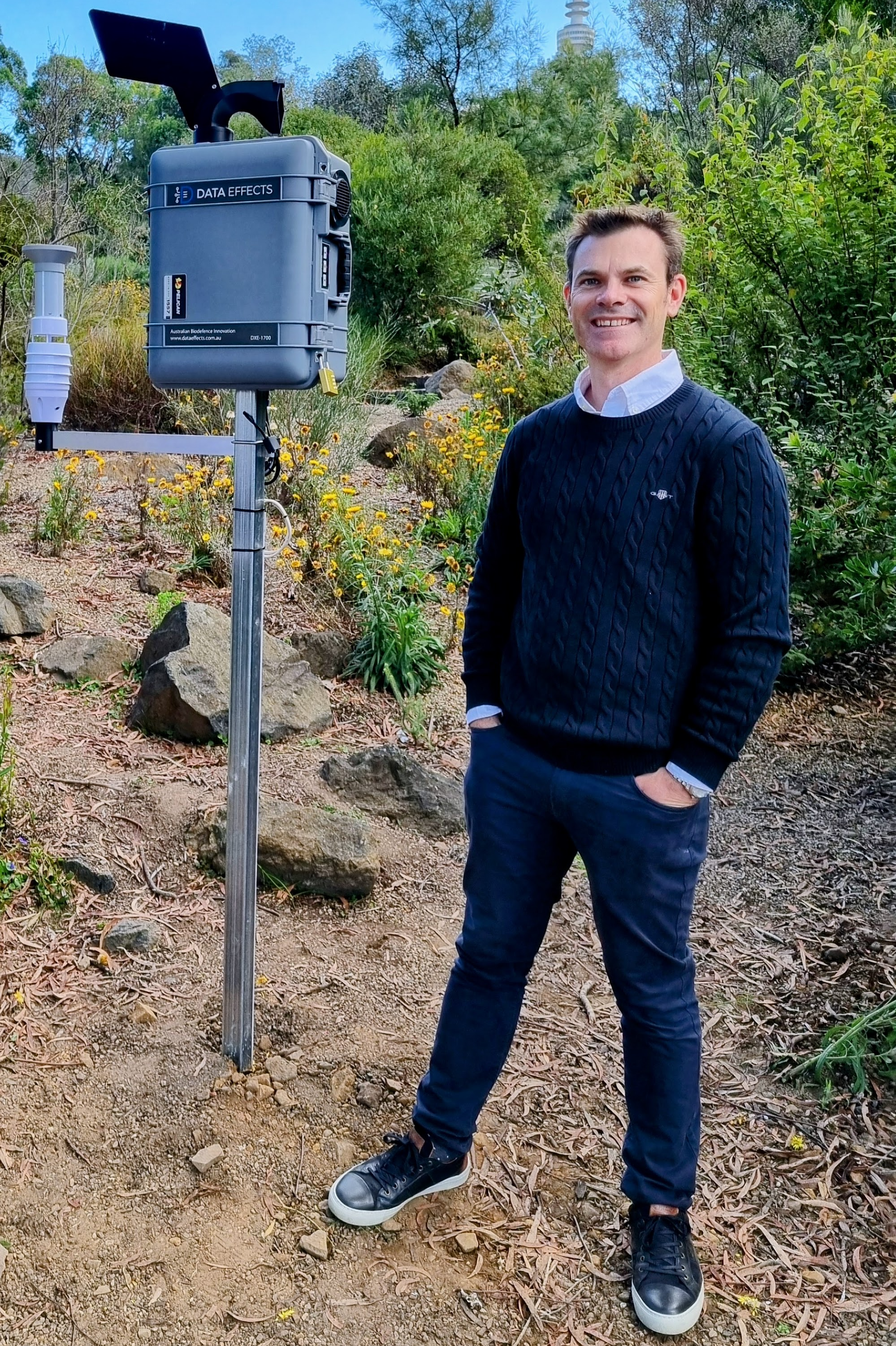
Dr Baker’s air samplers are each about the size of a couple of shoe boxes, and look a bit like hobbyist weather stations.
The samplers operate continuously, 24 hours a day, collecting airborne eDNA particles into vials. Each week they automatically replace the vials, capturing the average DNA present at each site for that week. The samples are then sent to the University of Canberra’s National eDNA Reference Centre for molecular analysis.
The sampling units also record rainfall, temperature, humidity, wind direction, and wind speed.
Finding ‘hidden’ species
Analysing air samples for eDNA can’t tell researchers how many of each species is out there, what they are up to, whether they are just passing through nor any other qualitative information. But it can tell whether a species exists nearby.
In Victoria, for example, eDNA technology was deployed in Melbourne waterways to find hidden populations of platypus, not yet reported by human observers.
To identify species, eDNA samples need to be checked against known DNA sequences (“bar codes”). These ‘bar codes’ are partial sequences of genome – originally extracted from preserved, dead specimens – which accurately identify what species the DNA came from.
It’s a bit like skimming through a car’s manual for the Vehicle Identification Number (VIN). If you’ve got the VIN, you don’t need the rest of the manual (ie the rest of the genome) to Google what make and model of car you are dealing with.
These bar code DNA sequences are held in various “libraries”, usually housed in research institutions and universities.
Such libraries are very far from complete. DNA bar codes identifying larger and better known species, such as many mammals, birds and fish, are increasingly available. But the bar codes of Australia’s tens of thousands of plant species, and hundreds of thousands of insect species, are only now starting to be recorded.
Late last year the CSIRO launched the National Biodiversity DNA Library (NBDL), which will draw on some of Australia’s largest biological collections, including the Australian National Insect Collection, the Australian National Fish Collection, the Australian National Wildlife Collection and various national and state herbariums.
The CSIRO’s NBDL uses a quick, low-cost technology called ‘genome skimming’ to extract identification bar codes from the animal and plant specimens held in storage in the collections. These bar codes can then be made available to researchers.
The NBDL released its first set of reference sequences (bar codes) in December 2025. NBDL director Dr Jenny Giles said the initial release covered about 2,500 species of marine fish and a selection of other marine organisms, with the sequences skimmed from specimens held in various museums and collections around Australia.
Dr Giles said the NBDL will be a game changer for eDNA technology, making it possible to monitor entire ecosystems quickly and at scale.
“While we can now generate huge numbers of DNA reads from water, soil and air samples, the lack of an extensive and reliable library like the NBDL to accurately identify them to species has really held back these powerful new techniques,” she said.
Sniffing for clues
In the meantime, Dr Baker’s volunteer work in our local Cox Creek catchment is something of a wildcat project – piggy backing on the work he already does through institutions such as the University of Canberra. He will only be able to identify species whose bar codes are already recorded and released, at least for now.
He said he was not sure what he will find, which was precisely the point.
“This is literally suck and see, that’s what it is.”
Six of his air samplers will be deployed in the Cox Creek area. A seventh will be deployed, as a kind of control, at nearby Warrawong Sanctuary. Warrawong, surrounded by a fox and cat proof fence, is a private sanctuary housing native species which are otherwise extinct in this catchment.
Dr Baker’s original intention was to try and track changes in the Cox Creek catchment as the project is rolled out, but he accepts that identifying changes will be a big ask given the short timescale, the un-availability of reference bar codes for many species and other limitations.
Instead he now sees it as establishing a baseline for future monitoring. In years to come, future researchers will be able to dig deeper into the data, and to see what has changed.
Dr Baker said he loved the idea that he was bringing exciting, cutting-edge technology to the sleepy Hills district he grew up in.
He said having a baseline of good quality eDNA samples would encourage other scientists to follow. He would like his beloved Adelaide Hills home to be a honey pot for future researchers, and for future conservation work.
“These quality data sets will continue to encourage them to come to this place to carry out their research,” he said.
He said it is important to demonstrate that projects like the Cox Creek rehabilitation are making a positive environmental difference, and that measuring biodiversity change using eDNA technology is one way of doing that.
“What we really need to be doing is give an example that things can be made better in the Adelaide Hills and elsewhere over time,” he said. “We need to show that there’s been a beneficial outcome.”
*****
NOTE TO SUBSCRIBERS & FOLLOWERS: I am migrating Old Manure to Substack. You can find it in future at: https://oldmanure.substack.com Please subscribe there instead.
Old Manure will still be free to subscribe and read, but it should be more user friendly. I will eventually shut down the website you are reading this on (oldmanure.com).


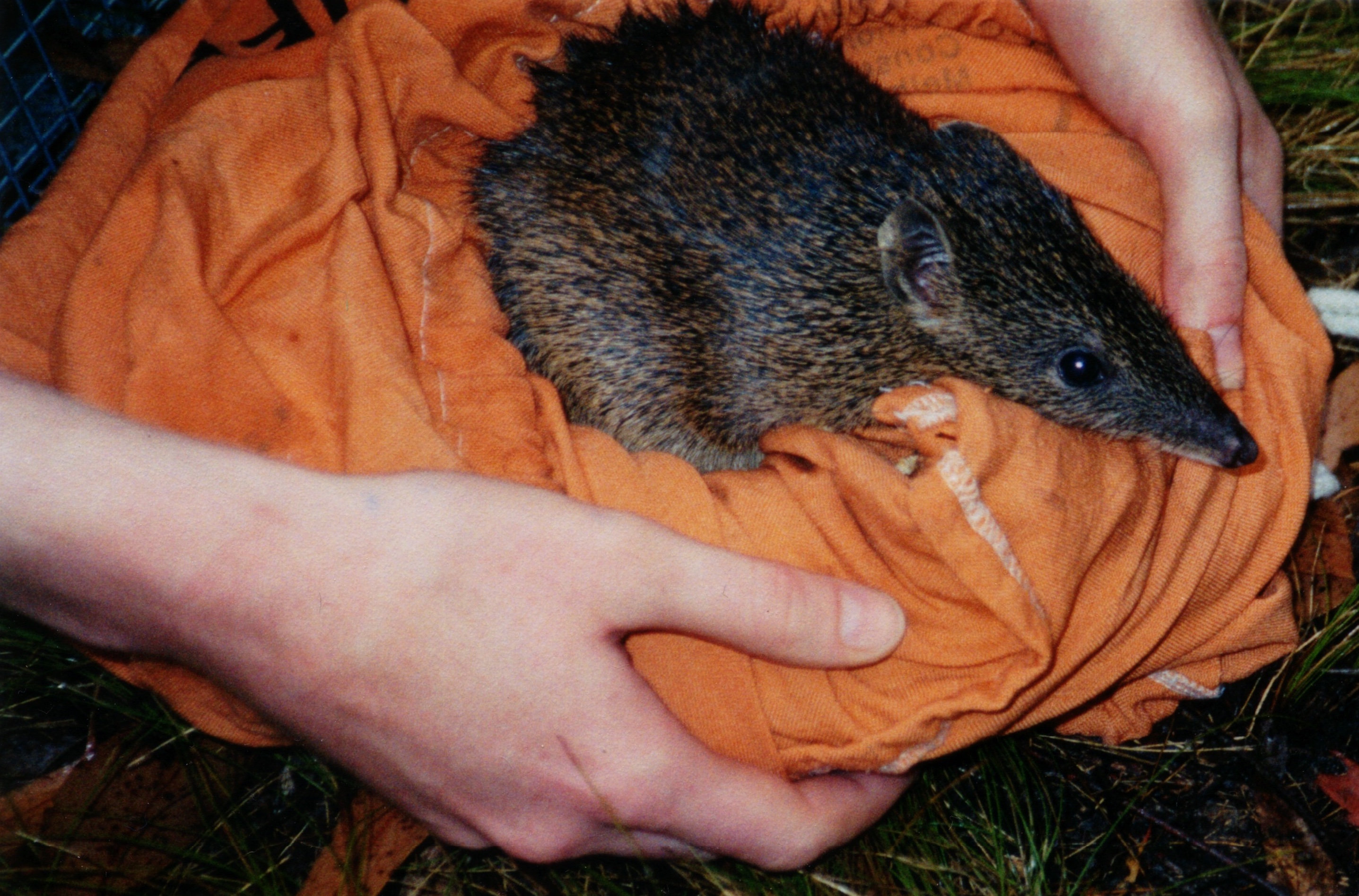
 For those who don’t know what a bush carer does, the work mostly consists of restoring native vegetation by removing invasive weeds.


